
When buyers compare CNC fiber laser cutting machines, they usually focus on machine power, cutting speed, and equipment price.
Those factors matter. But in real production, assist gas selection often has a larger impact on profitability than many shops expect.
A factory can install a high-power fiber laser and still struggle with:
- excessive grinding,
- unstable weld quality,
- inconsistent coating adhesion,
- or rising consumable costs.
In many cases, the issue is not the laser source or machine frame.
It is the gas strategy behind the process.
For most fabrication businesses, the practical rule is straightforward:
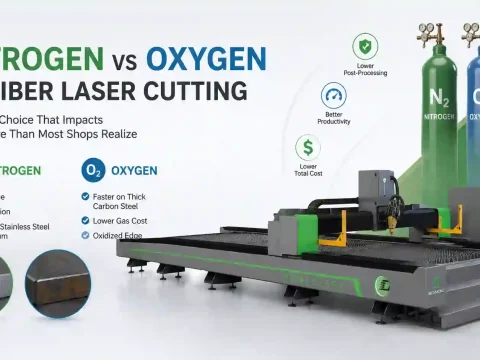
- Nitrogen is generally the better choice for stainless steel and applications requiring clean edges.
- Oxygen remains more economical for thick carbon steel processing where appearance is less critical.
The wrong gas choice rarely causes dramatic failure. More often, it slowly increases labor hours, rework, and downstream processing costs until production efficiency quietly disappears somewhere between the cutting table and the grinding station. Manufacturing has a remarkable ability to turn one overlooked parameter into three meetings and a delayed shipment.
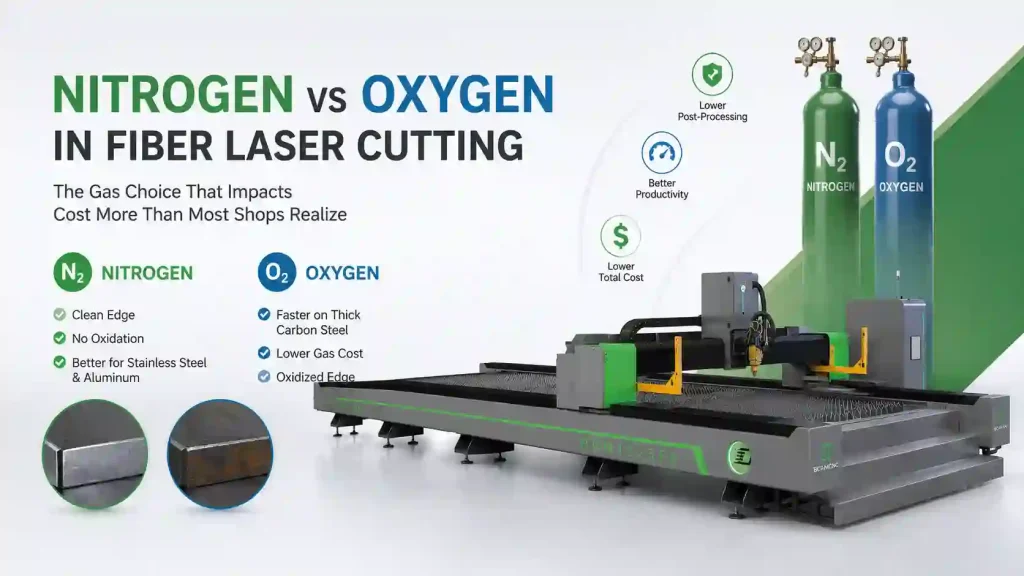
Assist gas is not simply used to remove molten metal from the cut.
It directly affects:
- edge quality,
- oxidation,
- cutting speed,
- heat input,
- welding compatibility,
- and total production cost per part.
The difference comes from how Oxygen and Nitrogen behave during the cutting process.
Oxygen: Additional Heat Through Chemical Reaction
Oxygen is considered an active assist gas.
During cutting, Oxygen reacts with hot steel and creates an exothermic reaction. Part of the metal burns during the process, generating additional thermal energy that supports the laser beam.
This helps:
- improve thick carbon steel cutting capability,
- reduce required laser power,
- and lower gas pressure demand.
That is why Oxygen is still widely used for:
- structural steel fabrication,
- agricultural equipment,
- construction machinery parts,
- and heavy industrial components.
For example, a 6kW fiber laser using Oxygen can efficiently process thick carbon steel that would otherwise require significantly higher power when cutting with Nitrogen.
The trade-off is oxidation.
Oxygen cutting usually produces:
- a darker cut edge,
- oxide scale,
- and additional cleanup before welding or powder coating.
For many structural applications, this is acceptable.
For appearance-sensitive parts, it often becomes a secondary processing problem.
Nitrogen: Cleaner Edges and Reduced Post-Processing
Nitrogen works differently.
It does not chemically react with the material. Instead, high-pressure Nitrogen mechanically removes molten metal from the kerf while protecting the cut edge from oxidation.
The result is typically:
- a brighter edge,
- improved cosmetic consistency,
- better welding performance,
- and reduced finishing workload.
Nitrogen is commonly preferred for:
- stainless steel,
- aluminum,
- decorative sheet metal,
- kitchen equipment,
- medical components,
- and parts requiring powder coating.
A typical 12kW fiber laser cutting 3mm stainless steel with 20 bar Nitrogen can achieve very high cutting speeds while maintaining clean, weld-ready edges.
For many shops, the biggest advantage is not visual appearance alone.
It is the reduction in downstream labor.
Real Production Example: When “Cheap Gas” Becomes Expensive
A fabrication company producing stainless steel electrical enclosures initially used Oxygen because gas cost was lower and operators were already familiar with the setup.
The parts cut successfully.
But downstream problems gradually appeared:
- weld discoloration,
- inconsistent powder coating adhesion,
- additional edge grinding,
- and rising labor hours during finishing.
The company later switched to Nitrogen for the same material thickness.
Gas cost increased noticeably.
However:
- manual grinding time dropped,
- weld consistency improved,
- rework decreased,
- and delivery stability improved.
The laser source did not change.
The machine frame did not change.
Only the assist gas changed.
Yet the overall production cost per finished part decreased because secondary processing became easier and more predictable. Factories rarely lose money through one catastrophic mistake. Usually it disappears slowly through overtime, rework, and operators carrying angle grinders across the workshop like exhausted medieval blacksmiths.
Practical Comparison Between Nitrogen and Oxygen
| Item | Nitrogen (N₂) | Oxygen (O₂) |
|---|---|---|
| Main Function | Prevent oxidation | Support combustion |
| Typical Materials | Stainless steel, aluminum | Carbon steel |
| Edge Appearance | Bright and clean | Dark oxidized edge |
| Cutting Speed | Faster on thin stainless | Better for thick mild steel |
| Gas Pressure | High | Low |
| Gas Consumption | Higher | Lower |
| Welding & Coating Compatibility | Excellent | Often requires cleaning |
| Secondary Processing | Reduced | Usually higher |
| Operating Cost | Higher gas cost | Lower gas cost |
The Hidden Cost Many Buyers Ignore
Machine quotations usually compare:
- machine structure,
- laser source brand,
- cutting thickness,
- and speed data.
Experienced engineers often focus on another question instead:
What happens after cutting?
Because in actual production:
- a slower clean cut may reduce total manufacturing cost,
- while a faster oxidized cut may increase labor later.
This becomes especially important when parts require:
- welding,
- polishing,
- powder coating,
- or cosmetic finishing.
For procurement teams, “cost per cut” and “cost per finished part” are rarely the same thing.
That distinction becomes more important every year as labor costs continue rising globally.
Where High-Pressure Air Fits In
Some high-power fiber laser users are adopting compressed air for thin-sheet applications to reduce Nitrogen consumption and operating cost.
However, compressed air is far less forgiving than many machine catalogs suggest.
Cutting performance depends heavily on:
- air pressure stability,
- dew point control,
- oil filtration,
- and overall air purity.
To protect optical components, compressed air quality should meet ISO 8573-1:2010 Class 1.2.1 standards.
Even small traces of oil vapor or moisture can cause:
- thermal lensing,
- contamination on protective windows,
- unstable beam transmission,
- and premature consumable failure.
In high-volume production, poor air quality often creates problems gradually rather than immediately. Operators may first notice inconsistent edge quality, increased nozzle heating, or unstable piercing before major optical damage becomes visible. Industrial maintenance has a habit of announcing expensive disasters through subtle warnings everyone ignores until the invoice arrives.
For many fabrication shops, compressed air works best as a supplementary cutting option rather than a complete replacement for Nitrogen or Oxygen.
What Buyers Should Ask Machine Suppliers
Instead of asking:
- “Which gas is better?”
- “How fast can the machine cut?”
- “What thickness can it handle?”
More useful questions are:
- What gas pressure is recommended at my target thickness?
- What is the estimated hourly gas consumption?
- Will oxide removal be required before welding?
- How does gas choice affect consumable life?
- What nozzle configuration is recommended?
- Can the machine maintain stable cutting during long production runs?
- What is the expected downstream finishing workload?
These questions usually reveal whether a supplier understands production realities or only machine specifications.
A Practical Gas Selection Strategy
Choose Nitrogen If:
- surface quality matters,
- stainless steel processing is common,
- welding consistency is important,
- customers require clean cosmetic edges,
- or downstream finishing cost is high.
Choose Oxygen If:
- thick carbon steel dominates production,
- structural applications are the priority,
- slight oxidation is acceptable,
- and minimizing gas expense matters more than edge appearance.
Consider Compressed Air If:
- you operate high-power fiber lasers,
- process mainly thin sheet metal,
- and have a stable industrial air system with proper drying and filtration.
Many mature fabrication shops use multiple gases depending on order type and material requirements.
That is usually the most economical long-term approach.
FAQ
Is Nitrogen always better than Oxygen in fiber laser cutting?
No. Nitrogen produces cleaner edges, but Oxygen is often more economical for thick carbon steel applications where minor oxidation is acceptable.
Why does Nitrogen cost more in laser cutting?
Nitrogen cutting usually requires significantly higher gas pressure and gas consumption. However, reduced grinding and rework may lower total production cost.
Can compressed air replace Nitrogen completely?
Not in all applications. Compressed air may work well for thin-sheet cutting, but stainless steel parts requiring cosmetic edges or high weld quality still typically benefit from Nitrogen.
Does Oxygen cutting affect welding quality?
Yes. Oxygen creates an oxide layer on the cut edge, which may require cleaning before welding or coating.
Need Help Choosing the Right Assist Gas?
Different materials, thicknesses, and production volumes require different gas strategies.
Our engineering team can help evaluate:
- Nitrogen vs Oxygen operating cost,
- estimated gas consumption,
- expected edge quality,
- downstream processing workload,
- and recommended air system configuration.
Send us your material type, thickness range, and current production requirements. We will provide a practical cutting solution based on real manufacturing conditions rather than theoretical cutting data.
Choosing the correct assist gas is not simply about cutting metal faster. It is about balancing edge quality, labor cost, process stability, and long-term production efficiency. Demo cuts are always beautiful. Real manufacturing starts when the machine runs continuously for ten hours on a Friday afternoon and every small process decision suddenly becomes very expensive.