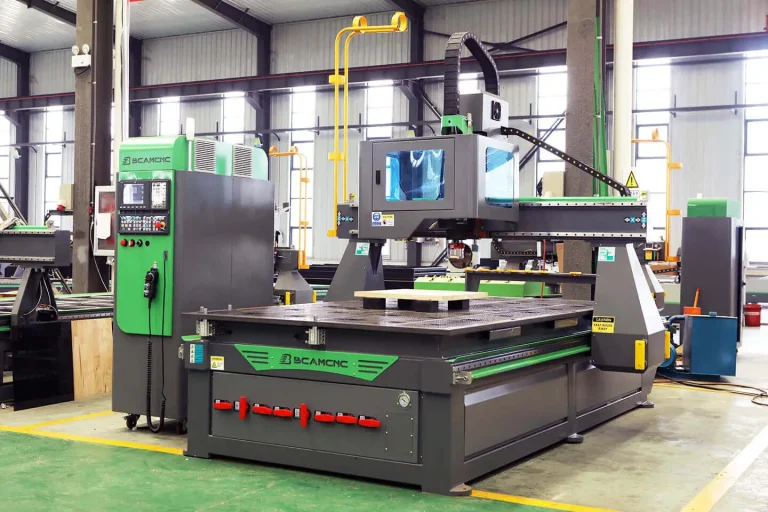

In the modern metal fabrication industry, precision, efficiency, and safety are paramount. Fiber laser cutting machines have revolutionized the way manufacturers cut metals, providing high-speed, high-precision results. Among the latest innovations, automatic obstacle avoidance technology stands out as a game-changer for both productivity and safety. In this article, we will explore the principles, benefits, and applications of this technology, while referencing our demonstration video that showcases BCAMCNC’s fiber laser cutting machine in action.
What is Automatic Obstacle Avoidance in Laser Cutting?
Automatic obstacle avoidance is an intelligent feature integrated into advanced fiber laser cutting machines. The system detects foreign objects, clamps, fixtures, or any unexpected items on the cutting bed and automatically adjusts the cutting path to avoid collisions. This ensures uninterrupted cutting operations while protecting the equipment from potential damage.
In the video demonstration, you can see the laser head seamlessly changing direction when it encounters obstacles, maintaining precision while preventing errors. This capability allows operators to focus on more critical aspects of production, reducing the risk of accidents and downtime.
How Does the Technology Work?
The core of automatic obstacle avoidance lies in a combination of sensors, real-time path planning, and CNC control algorithms.
-
Sensors and Detection: High-precision sensors scan the cutting area in real-time, identifying obstacles or irregularities on the material surface.
-
Path Adjustment: When an obstacle is detected, the system calculates an alternative cutting trajectory to bypass the obstruction without affecting the final shape.
-
CNC Integration: The adjusted path is immediately communicated to the CNC controller, ensuring smooth movement of the laser head and continuous cutting performance.
This sophisticated coordination between hardware and software enables uninterrupted operations and reduces human intervention, which is especially important for large-scale or complex cutting projects.
Benefits of Automatic Obstacle Avoidance
-
Enhanced Productivity: Machines can operate longer without interruption, minimizing downtime caused by manual adjustments or collisions.
-
Improved Safety: By detecting obstacles in real-time, the system protects both operators and the equipment from potential accidents.
-
Higher Accuracy: Maintaining consistent cutting precision, even when rerouting around obstacles, ensures high-quality output.
-
Reduced Material Waste: Avoiding collisions prevents scratches, burns, or deformation of sheets, saving material costs.
-
Simplified Operations: Operators can manage complex cutting tasks with less supervision, thanks to automated path adjustments.
Applications in the Metal Fabrication Industry
Automatic obstacle avoidance is highly valuable across multiple industries:
-
Sheet Metal Fabrication: Cutting stainless steel, aluminum, or mild steel sheets with minimal human supervision.
-
Automotive Parts Manufacturing: Producing intricate components while avoiding clamps or other fixturing tools on the cutting bed.
-
Industrial Equipment Production: Handling heavy or irregularly shaped metal pieces without compromising safety.
-
Construction and Architecture: Precision cutting of decorative metal panels, stair components, or structural parts.
The video demonstration clearly shows how the laser machine adjusts its path when it encounters clamps and other obstacles, highlighting its adaptability in real-world scenarios.
Why Choose BCAMCNC Fiber Laser Machines?
BCAMCNC has decades of experience in designing and manufacturing high-quality fiber laser cutting machines. Integrating automatic obstacle avoidance technology not only enhances machine efficiency but also ensures operational safety, reliability, and longevity.
Key advantages of BCAMCNC fiber laser machines include:
-
High-Speed Cutting: Reduce cycle times for large-scale production.
-
Advanced CNC Control: Precise and repeatable cuts.
-
User-Friendly Interface: Easy setup and operation.
-
Robust Build: Durable components to withstand continuous industrial use.
By combining intelligent software, advanced sensors, and precision engineering, BCAMCNC provides a solution that addresses common production challenges, including obstacle management, operator safety, and material protection.
Conclusion
Automatic obstacle avoidance is no longer a futuristic concept—it is a practical solution for modern fiber laser cutting operations. By allowing machines to detect and bypass obstacles autonomously, manufacturers can achieve higher productivity, better quality, and safer working conditions.
Watch the demonstration video to see BCAMCNC’s fiber laser cutting machine in action, showcasing its intelligent path adjustment and high-precision performance.
For more information on BCAMCNC fiber laser machines and custom solutions for your manufacturing needs, contact our team today.