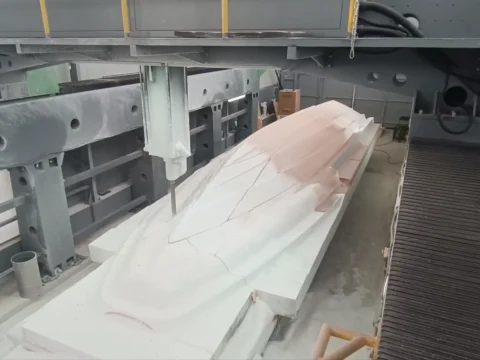

If your parts require undercuts, deep cavities, or multi-sided precision, a 5-axis CNC router is not optional.
And let’s be blunt:
If you are still flipping parts by hand to machine complex geometries, you are not saving money—you are burning it.
The labor cost, alignment errors, and scrap rates will quietly cost you more than a 5-axis machine within months.
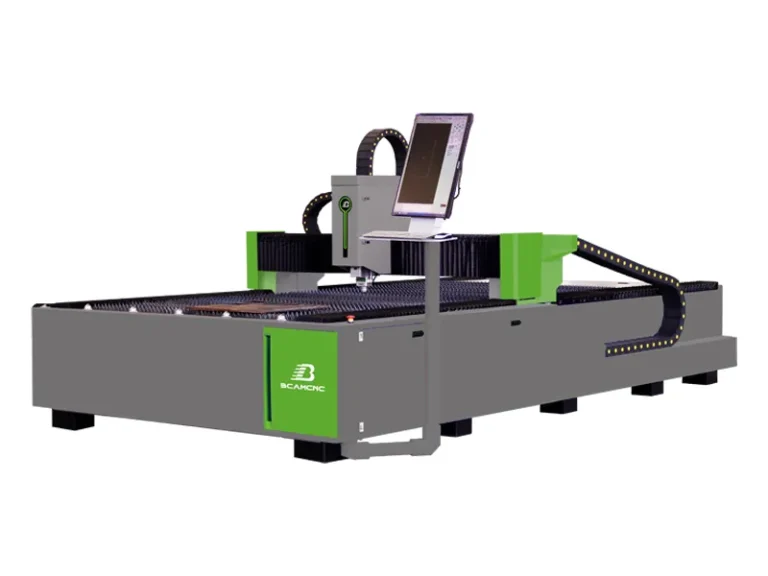
On the other hand, if your business is focused on flat panels, cabinetry, or standard 2.5D work, a high-quality 3-axis router will outperform a 5-axis machine in cost efficiency every time.
1. The Real Difference: From Linear Cutting to Spatial Machining
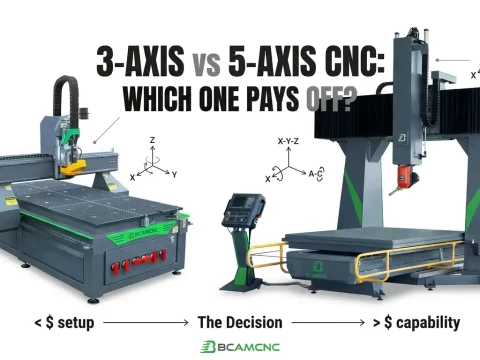
A 3-axis machine moves the tool in straight lines.
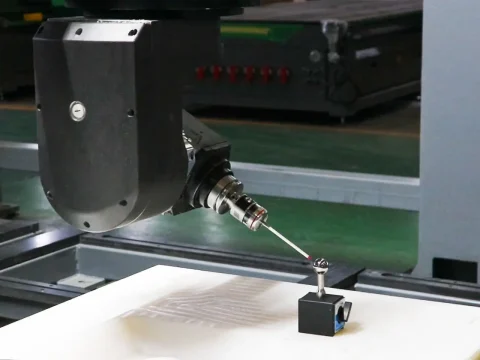
A 5-axis machine controls how the tool meets the material in space.
- 3-Axis (X, Y, Z): Tool is always vertical
- 5-Axis (X, Y, Z + A/C): Tool angle changes dynamically
This difference is not theoretical—it determines whether a part is:
- easy to machine
- slow and error-prone
- or completely impossible
2. What Actually Changes in Production
Setup Time → Labor Cost
- 3-axis: Multiple setups, manual repositioning
- 5-axis: One setup, full machining
Every time an operator touches a part, you introduce:
- alignment error
- time loss
- inconsistency
Less setup = fewer mistakes = lower real cost
Tool Access → Part Complexity
A 3-axis machine cannot reach:
- undercuts
- angled cavities
- complex surfaces
A 5-axis machine can approach from any direction.
This is the difference between:
- simplifying your design to fit the machine
- or letting the machine match your design
Tool Life & Surface Finish (Where Engineering Meets Money)
Here’s where most articles stay shallow. Let’s not.
In 3-axis machining:
- Long tools are required for deep cavities
- This causes deflection and chatter
- Result: poor surface finish and higher scrap rates
In 5-axis machining:
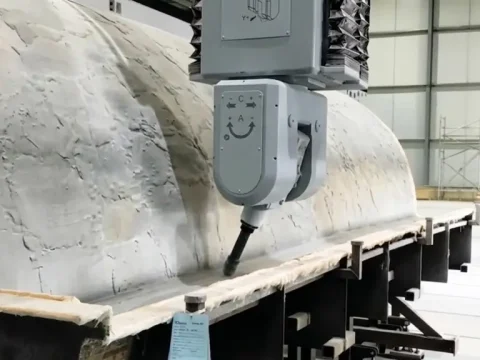
- The tool can be tilted
- Shorter, more rigid tools can be used
- Cutting happens along the optimal flute section
Translation to business:
- better finish → less sanding and rework
- longer tool life → lower consumable cost
- fewer defects → higher yield
3. The Hidden Layer: TCPM and Why It Matters
Most buyers never hear about this until it’s too late.
5-axis machines rely on TCPM (Tool Center Point Management).
This ensures that as the tool rotates, the cutting point stays perfectly aligned with the programmed path.
Without proper TCPM:
- your toolpath is mathematically wrong
- your part accuracy collapses
This is why 5-axis is not just a machine upgrade—it’s a process upgrade:
- CAM software must support it
- operators must understand it
If your team cannot handle this, a 5-axis machine will not fix your problems—it will amplify them.
4. When 5-Axis Is a Non-Negotiable Investment
A. Undercuts and Complex Geometry
If your parts include features that cannot be reached vertically,
a 3-axis machine simply cannot do the job—no matter how skilled the operator is.
B. Deep Cavities Without Compromising Accuracy
Using long tools on a 3-axis machine:
- increases vibration
- reduces precision
- damages surface quality
A 5-axis machine solves this by changing tool orientation instead of tool length.
C. Multi-Sided Precision Parts
If your workflow involves flipping parts multiple times:
You are introducing cumulative error.
A 5-axis machine completes:
- multiple faces
- in one setup
- with consistent spatial accuracy
D. High Scrap or Rework Rates
If you are regularly:
- re-machining parts
- sanding excessively
- fixing alignment mistakes
You don’t have a “skill problem.”
You have a machine capability mismatch.
5. When 3-Axis Is Still the Smarter Business Decision
Let’s not pretend every shop needs 5-axis.
A 3-axis CNC router is the better choice when:
- your products are flat or panel-based
- you run high-volume, repeatable jobs
- your margins depend on throughput, not complexity
- your team is not trained in advanced CAM workflows
In these cases, a 5-axis machine will sit underutilized—and become a very expensive decoration.
6. Decision Framework (Based on Real Shop Conditions)
Before investing, answer these honestly:
- How often do we manually reposition parts?
- Are we losing time due to multiple setups?
- Do our designs require angled or hidden features?
- Are we using long tools that reduce accuracy?
- How much do rework and scrap cost us monthly?
- Can our team handle 5-axis programming and TCPM?
- Will this capability increase our product value—or just our costs?
If most of your answers point to inefficiency, limitation, or lost opportunity,
then 5-axis is not an upgrade—it is overdue.
Final Thought
This is not a decision about technology.
It is a decision about how your business produces value.
A 3-axis machine is optimized for efficiency.
A 5-axis machine is optimized for capability.
Choose based on what your work demands—not what looks impressive on paper.
At BCAMCNC, we don’t recommend machines based on specifications.
We recommend them based on whether they actually improve your production reality.