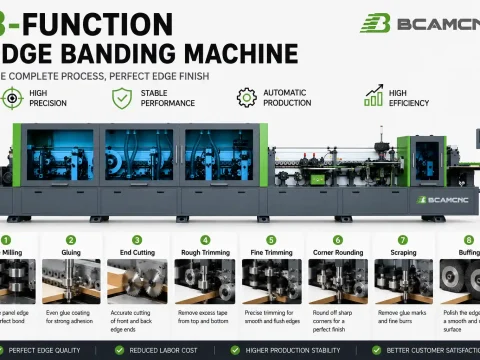

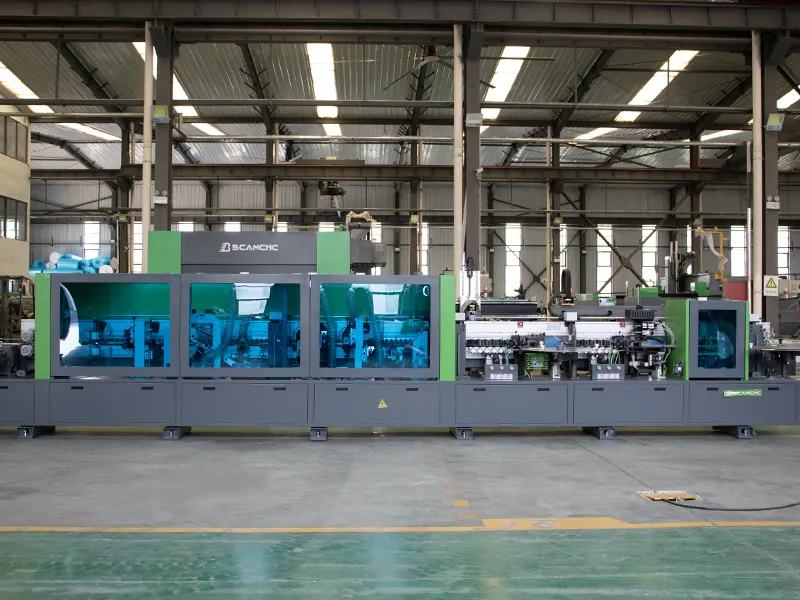
Most factories do not buy an 8-function edge banding machine because they need “more functions.” They buy it because manual repair work is already eating the profit.
If operators are still using hand scrapers to clean glue lines, polishing corners manually, or sorting panels after edge banding because “some pieces look bad,” the production line is already unstable. At that point, the machine is no longer just equipment. It becomes a daily compensation tool for upstream problems.
The uncomfortable truth is this:
A clean edge is easy.
A stable edge after 10 hours of continuous production is difficult.
That difference is where most factories either recover labor cost or quietly lose margin every month.
Why Edge Banding Quality Usually Fails Before the Glue Pot
Pre Milling Is Not Optional on Modern Furniture Production
A surprising number of factories still underestimate pre milling.
Then they spend the next six months adjusting glue temperature, changing PVC suppliers, replacing trimming blades, and blaming operators for defects that actually started at the panel edge.
If the CNC nesting machine leaves:
- slight chipping
- stepping
- saw vibration marks
- melamine breakout
- uneven board edges
the glue station is already trying to compensate for a damaged surface.
A proper pre milling unit normally removes around 0.1 mm to 0.3 mm per side depending on board quality and edge tape thickness.
Too little removal:
- defects remain under the tape
Too much removal:
- panel dimensions drift
- assembly tolerances start moving
- narrow panels become inconsistent
Factories processing low-density particle board usually benefit most from pre milling because board density variation is severe. MDF behaves more predictably. Plywood creates a different problem entirely because veneer layers cut unevenly under changing pressure.
Most operators hear pre milling problems before they see them.
The cutting sound changes first.
A stable pre milling setup depends on:
- spindle balance
- cutter concentricity
- feed synchronization
- dust extraction airflow
- air pressure stability
- tool wear consistency
Poor dust extraction alone can destroy edge quality over time. Chips recut against the surface and create microscopic tearing. The panel may still pass inspection initially, then PVC shrinkage exposes the glue line several weeks later under showroom lighting.
Customers rarely understand machining quality.
They absolutely notice visible edge lines.
Glue Temperature Means Less Than Temperature Stability
Most EVA glue systems run around 180°C to 200°C.
Reaching temperature is easy.
Holding stable temperature during continuous production is the real challenge.
When glue temperature fluctuates more than about ±5°C during high feed production, viscosity changes begin affecting coating consistency.
Then the chain reaction starts:
- weak adhesion
- inconsistent glue lines
- excessive squeeze-out
- scraping instability
- glue carbonization
- more cleaning downtime
A common factory mistake:
Operators increase glue temperature to compensate for poor bonding caused by dull pre milling cutters or contaminated board edges.
It works temporarily.
Then carbon buildup accelerates inside the glue pot, adhesive degradation becomes worse every shift, and maintenance slowly turns into daily survival.
PUR glue improves moisture resistance and reduces visible glue lines, especially on high-gloss furniture.
But PUR also introduces stricter maintenance discipline.
Technically, you can run PUR carelessly.
You can also ignore oil changes in a truck. The engine eventually explains the decision.
Factories switching between EVA and PUR without a proper quick-change glue system usually underestimate cleaning time badly.
Friday night shutdown becomes Monday morning maintenance.
End Cutting Problems Often Come From Panel Movement
When end cutting starts chipping intermittently, many factories replace blades immediately.
Sometimes the cutter is fine.
The real issue is panel instability.
Pressure beam inconsistency, encoder lag, feed chain vibration, or unstable pneumatic response can slightly shift the panel during cutting.
High-gloss acrylic panels expose this immediately.
For laser edge tape or acrylic edge materials, feed synchronization becomes extremely sensitive. A machine running cleanly at 18 m/min may suddenly create edge breakout at 24 m/min simply because pressure timing no longer matches board travel speed.
This is why experienced factories test edge banders using:
- narrow panels
- mixed panel sizes
- irregular production batches
Not just full-size showroom samples.
Any machine can look beautiful on standard demonstration panels for twenty minutes.
Production reality starts around week three.
Usually right after somebody skips maintenance to catch a shipment deadline.
Rough Trimming and Fine Trimming Decide Whether Corner Rounding Succeeds
Corner rounding gets blamed for many defects it did not create.
If rough trimming leaves inconsistent overhang thickness, fine trimming compensates unevenly. Then corner rounding removes material under changing load conditions.
That creates:
- edge whitening
- inconsistent radius
- PVC tearing
- vibration marks
- gloss inconsistency
- corner chipping
Dark matte PET panels are especially unforgiving here.
Some factories quietly reduce feed speed to hide the problem.
Scrap rate improves slightly.
Output drops gradually.
Nobody notices profitability getting worse because production numbers still “look acceptable” on paper.
This happens more often than most managers realize.
Scraping and Buffing Are Production Processes, Not Cosmetic Features
Cheap edge banding discussions usually stop at trimming.
Real factories know scraping determines whether the edge looks professionally finished or mass-produced in a hurry.
Proper scraping removes:
- residual knife marks
- glue residue
- micro whitening
- trimming stress lines
Without cutting into the decorative surface.
Improper scraper pressure creates:
- white stress marks
- haze
- heat streaks
- edge deformation
Thin ABS tape below 0.8 mm is particularly sensitive.
Buffing also matters more than many buyers expect.
End users rarely understand spindle quality or servo systems.
They instantly notice uneven gloss reflection along cabinet edges.
Residual glue contamination after buffing becomes even more visible several months later in humid environments, especially on white furniture.
The factory already shipped the order by then.
The installer gets blamed.
The brand reputation absorbs the damage quietly.
8-Function vs Standard Edge Banding Setup
| Feature | 8-Function Edge Bander | Standard 5/6-Function Machine | Real Factory Impact |
|---|---|---|---|
| Pre milling | Included | Usually absent | Stabilizes poor board edges |
| Glue consistency | Better process continuity | More operator compensation | Reduces glue line variation |
| Corner rounding | Automatic tracking | Manual repair often needed | Improves premium furniture finish |
| Trimming quality | Multi-stage trimming stability | Higher risk of whitening | Better edge consistency |
| Scraping | Dedicated process | Often simplified | Reduces manual rework |
| Buffing | Stable finish output | Inconsistent gloss | Better customer perception |
| Labor dependency | Lower | Higher | Less operator skill dependency |
| Rework rate | Lower in continuous production | Higher manual correction | Better long-term ROI |
A Real Factory Case: The Machine Was Not the Main Problem
A furniture factory in Southeast Asia upgraded from a basic 5-function edge bander to a full 8-function production line.
Production volume:
- 350 to 500 panels per shift
- 18 mm melamine particle board
- mixed matte and textured surfaces
- PVC edge tape from multiple suppliers
The factory expected immediate quality improvement.
Instead, they still experienced:
- inconsistent trimming
- occasional corner whitening
- unstable end cutting quality
The first assumption was machine calibration failure.
After inspection, the real issues were:
- board thickness variation reaching ±0.25 mm
- insufficient dust extraction airflow
- compressed air dropping below 0.6 MPa during peak demand
- operators manually adjusting trimming pressure throughout the shift
- inconsistent PVC batches from different suppliers
The machine itself was functioning correctly.
After stabilizing compressed air supply, improving dust collection, and standardizing edge tape sourcing, reject rate reportedly dropped from around 7% to below 2.5%.
Not because the machine became “better.”
Because the process finally became predictable.
Factories often want equipment solutions for process management problems.
Sometimes the most expensive machine in the workshop is compensating for the cheapest operational mistake.
The Hidden Cost Most Buyers Ignore: Pneumatic Stability
Edge banders are pneumatic systems as much as mechanical systems.
If workshop air pressure fluctuates between 0.5 MPa and 0.7 MPa because the compressor is undersized or poorly maintained, cylinder timing stops matching feed movement accurately.
Then problems appear everywhere:
- end cutting inconsistency
- trimming instability
- pressure roller variation
- corner rounding misalignment
Operators keep adjusting settings.
The defects keep returning.
Stability starts at the air tank, not just the machine frame.
This is one of the least discussed but most common causes of inconsistent edge quality in medium-sized furniture factories.
Maintenance Usually Fails Because Cleaning Discipline Fails
Most edge banding downtime is not catastrophic failure.
It is accumulated neglect:
- glue residue buildup
- MDF dust contamination
- pneumatic water accumulation
- unbalanced trimming cutters
- dirty linear guides
- overdue lubrication
MDF dust is especially destructive over time. Fine particles migrate into:
- sensors
- valves
- encoders
- bearing surfaces
- pneumatic components
Many factories underestimate workshop environment changes as well.
In tropical climates, glue behavior can change noticeably between morning and afternoon production.
Night shift edge quality often behaves differently from day shift quality even using identical settings.
Experienced operators know this immediately.
Management reports usually do not.
FAQ
Is an 8-function edge banding machine necessary for every factory?
No.
Factories producing simple cabinets with low cosmetic requirements may achieve better ROI using a stable 5 or 6-function machine with lower maintenance complexity.
An 8-function configuration becomes more valuable when producing:
- high-gloss furniture
- matte PET panels
- acrylic edge applications
- premium cabinetry
- mixed batch production
What feed speed is realistic for stable production?
For many factories, stable continuous production happens around 16 to 22 m/min.
Higher speeds are possible under controlled conditions, but long-term stability depends heavily on:
- board consistency
- tooling condition
- dust extraction
- operator experience
- glue system response
Peak showroom speed and stable production speed are usually two different numbers.
Does PUR glue always produce better results?
Not automatically.
PUR improves:
- moisture resistance
- heat resistance
- invisible glue line performance
But PUR also requires:
- strict cleaning discipline
- controlled shutdown procedures
- proper storage conditions
- better operator training
Factories without stable maintenance systems sometimes achieve better long-term results using high-quality EVA adhesive.
Why does edge whitening appear even after fine trimming?
Usually because stress already exists in the edge material before trimming.
Common causes include:
- excessive trimming pressure
- unstable panel feeding
- incorrect corner rounding load
- poor tape quality
- dull tooling
- improper scraper adjustment
Replacing blades alone often does not solve the root problem.
The Purchasing Question Most Factories Ask Wrong
The wrong question is:
“How many functions does the machine have?”
The better question is:
“How stable will production still be after six months of continuous operation?”
A reliable 8-function edge banding machine is valuable because it reduces process compensation across the workshop:
- less manual correction
- less operator dependency
- less hidden rework
- fewer QC disputes
- more predictable delivery quality
That is where the real ROI comes from.
When evaluating an edge banding machine, factories should pay closer attention to:
- long-shift temperature stability
- pneumatic component quality
- servo synchronization
- dust extraction design
- tooling accessibility
- calibration simplicity
- local technical support
- spare parts response time
Not just polished sample panels under exhibition lighting.
Every machine looks impressive during a short demonstration.
Production reality begins after thousands of panels, mixed materials, overtime shifts, rushed deliveries, tired operators, dirty workshops, unstable air supply, and the third time somebody says:
“Just increase the glue temperature a little more.”