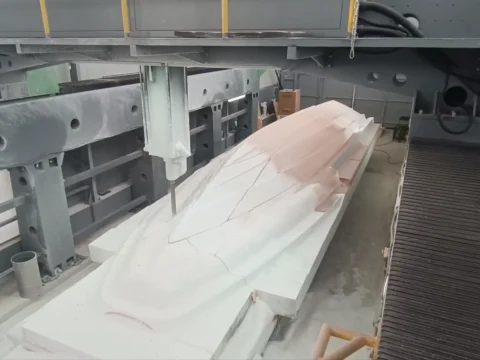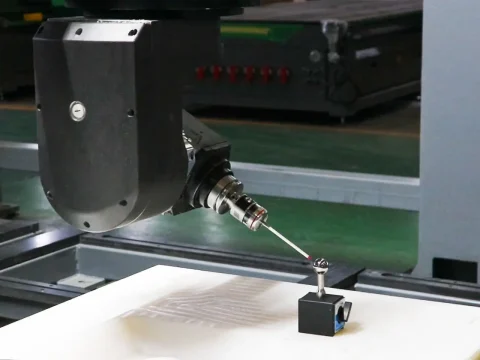

With the continuous development of the furniture industry, the classification of CNC woodworking machines has become increasingly diverse to meet the different needs of the industry.
Currently, the mainstream CNC woodworking machines include three-axis CNC woodworking machines, four-process CNC Wood Routers, and automatic tool-changing CNC Wood Routers.
These advanced devices have been widely applied in the wood processing industry, playing a crucial role in tasks such as wood cutting, carving, and drilling.
BCAMCNC is a well-known brand in the field of CNC woodworking machines, offering a range of efficient and precise processing solutions for furniture manufacturers.
Below is a detailed introduction to the three mainstream CNC woodworking machines, helping you choose based on your workshop’s processing scale.

1. Heavy-duty 3-axis CNC Wood Router
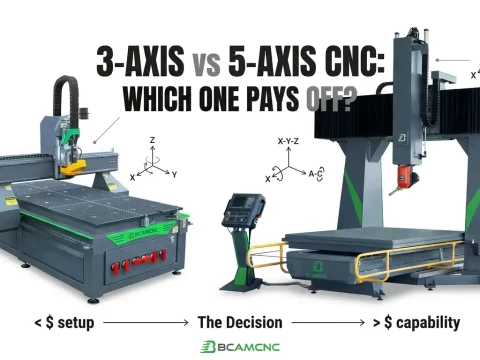
BCAMCNC’s heavy-duty 3-axis CNC Wood Router is a fundamental woodworking carving device, featuring a spindle from the CE-certified HQD brand.
The machine offers multiple power options, effortlessly handling the carving and cutting tasks for sheet materials. To enhance work efficiency, it is equipped with auxiliary wheels,
especially useful when processing large-area sheet materials to reduce the labor intensity of workers.If you’re in the furniture industry and need to process cylindrical materials like table legs and chair legs in addition to carving flat materials,
adding a rotary axis device to the heavy-duty 3-axis CNC Wood Router would be a good choice. The rotary axis can be installed on the machine’s side or directly on the CNC machine table,
providing convenience.
2. Four-process CNC Wood Router
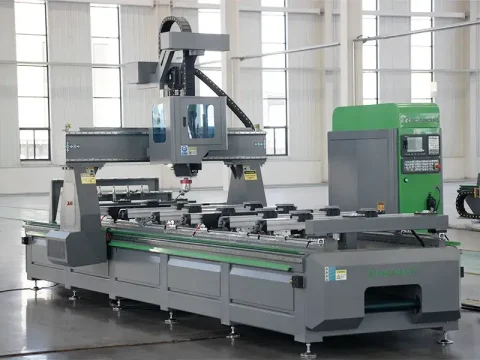
BCAMCNC’s four-process CNC woodworking cutting machine is an economical CNC cutting device, also known as an ATC CNC Wood Router, as it features four independently working spindles.
In this machine, all four spindles can work continuously without the need to stop for tool changes.
Three spindles are installed side by side on the machine head, achieving faster tool-changing speeds and higher processing accuracy.
The functionality of the four-process cutting machine is comprehensive, suitable for cutting sheet furniture and milling cabinet doors, among other applications.
This CNC Wood Router is suitable for carving different patterns on the same sheet, reducing manual tool-changing time and improving workshop processing efficiency.
3. Automatic Tool-changing CNC Wood Router
If your workshop is large-scale or your furniture emphasizes intricate carving, BCAMCNC’s automatic tool-changing CNC machine will provide significant assistance.
The automatic tool-changing CNC Wood Router is an advanced CNC carving equipment and represents the trend in CNC machine tool development.
It features an independent tool magazine, enabling automatic tool changes during the workpiece processing without stopping operations.
When carving complex patterns, you can choose different tools, significantly improving work efficiency while ensuring high product quality.
Through the classification introduction of these three popular CNC woodworking machines, it is believed that wood processing enterprises have gained a preliminary understanding of the characteristics and applicable scenarios of these devices.
When selecting carving machine equipment, consider your workshop conditions and requirements to choose the suitable equipment for effectively improving production efficiency.
BCAMCNC is dedicated to providing outstanding CNC carving solutions for customers and is a reliable partner you can trust.