
Small factories don’t fail because they lack orders. They fail because they can’t balance three things at the same time:
- Precision that holds over long runs
- Throughput that keeps delivery promises real
- Overhead that doesn’t quietly eat the margin
Push one, and the other two usually break. Faster cutting ruins accuracy. Higher precision slows output. Cutting costs introduces instability. That’s the daily math on the shop floor.
BCAM CNC routers are built around that exact conflict. Not to optimize everything, but to keep those three forces in a workable balance.
Precision That Survives Time, Not Just the First Part
Most machines can hit tolerance on the first few parts. That’s easy. The real problem shows up after 6–10 hours of continuous cutting.
Heat builds. Structure shifts. Tool wear compounds. Suddenly your ±0.05 mm becomes ±0.2 mm, and now you’re reworking parts instead of shipping them.
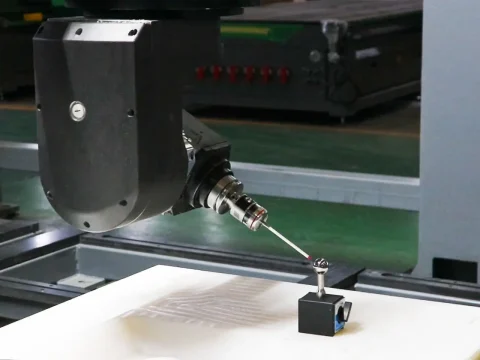
BCAM focuses on structural rigidity and thermal stability:
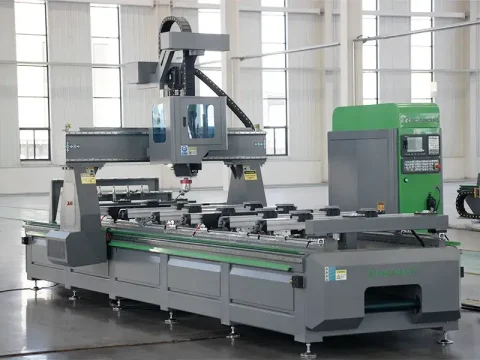
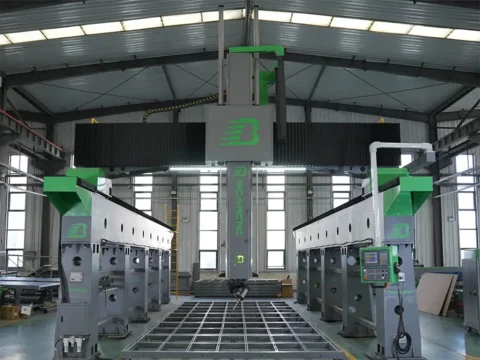
- Heavy gantry design reduces vibration during multi-axis movement
- Stable spindle performance under continuous load
- Consistent axis positioning over long cycles
This matters for small-batch production with high repeatability requirements, where you don’t have the luxury of scrapping parts.
Trade-off: you’re not getting the cheapest machine. But you’re also not paying for scrap and rework later.
Throughput Comes From Less Stopping, Not Just Faster Cutting
Spindle speed looks impressive in a brochure. It doesn’t matter if the machine is idle half the time.
Throughput in real shops is controlled by interruptions:
- Repositioning parts
- Manual alignment
- Tool changes
- Setup between batches
BCAM routers reduce those hidden delays:
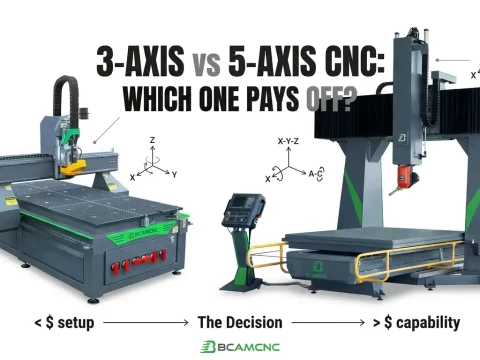
- Multi-axis capability minimizes repositioning
- One-setup machining for complex parts
- Stable motion control for efficient tool paths
For custom machining jobs and small-lot production, this is where time is actually lost.
You don’t win by cutting 10% faster.
You win by removing 30% of non-cutting time.
Setup Time Is Where Small Factories Bleed Money
Large factories can hide inefficiency across volume. Small factories can’t.
If your operator spends 40 minutes setting up for a 2-hour job, your margins are already gone.
BCAM helps reduce setup dependency:
- Predictable machine behavior reduces trial-and-error
- Consistent fixturing compatibility
- Reliable zero-point and alignment processes
This directly supports operational cost reduction in low-volume production environments.
You still need a skilled operator.
But you stop wasting that skill on avoidable adjustments.
Material Utilization Is a Quiet Profit Driver
Nobody talks about material yield. They should.
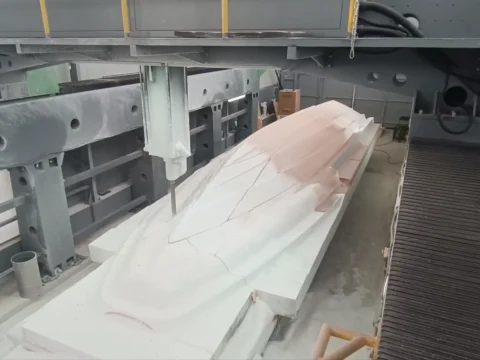
In wood, foam, or composite machining, poor nesting and unstable cutting lead to waste that adds up fast.
BCAM routers support better material use through:
- Stable cutting paths that reduce deviation
- Clean edge quality, reducing scrap
- Compatibility with nesting strategies for irregular shapes
For shops doing CNC routing for furniture, doors, or patterns, this directly impacts cost per part.
Less waste means higher margin. It’s not complicated.
Reliability Is Not a Feature. It’s the Business Model.
Breakdowns don’t just stop production. They create chain reactions:
- Missed deadlines
- Overtime labor
- Rush shipping costs
- Customer trust erosion
BCAM machines are built for long-cycle machine reliability:
- Durable components for continuous operation
- Reduced maintenance frequency
- Predictable performance under load
No machine is failure-proof.
But predictable machines are manageable. Random ones are expensive.
Small factories need predictability more than peak performance.
Where BCAM Actually Fits (And Where It Doesn’t)
BCAM CNC routers make sense if:
- You run high-mix, low-volume production
- You need consistent precision across long cycles
- You want to reduce setup time and operator dependency
- You care about total operational cost, not just purchase price
They are less ideal if:
- You run simple parts at massive volume
- Your only decision factor is lowest upfront cost
That second group usually learns the same lesson later, just at a higher price.
The Real Advantage: Control
Small factories don’t grow because they buy machines.
They grow because they gain control over their process.
- Control over tolerance
- Control over delivery time
- Control over cost per part
BCAM doesn’t remove complexity.
It removes instability.