
Most 5-axis CNC routers look impressive during machine acceptance tests. The real evaluation starts six months later, when the machine is running carbon fiber parts for ten hours straight, operators begin overriding feed rates to suppress vibration, and surface defects start showing up downstream during assembly or paint inspection.
That is where aerospace machining separates “general-purpose 5-axis” equipment from machines actually built for production stability.
At BCAMCNC, the decision to integrate the FAGOR 5-axis CNC system on selected aerospace and composite machining platforms did not come from branding considerations. It came from recurring shop-floor problems we kept seeing in large-format composite machining:
- unstable RTCP behavior during simultaneous motion
- contour marks on curved surfaces
- thermal drift during long machining cycles
- feed fluctuation in dense toolpaths
- excessive hand finishing after trimming operations
- inconsistent results between shifts
Most of these issues do not appear in brochures. They appear at 2:00 AM during production runs when operators start compensating for machine behavior manually just to keep parts moving.
Why BCAMCNC Strengthened Cooperation with FAGOR in Spain
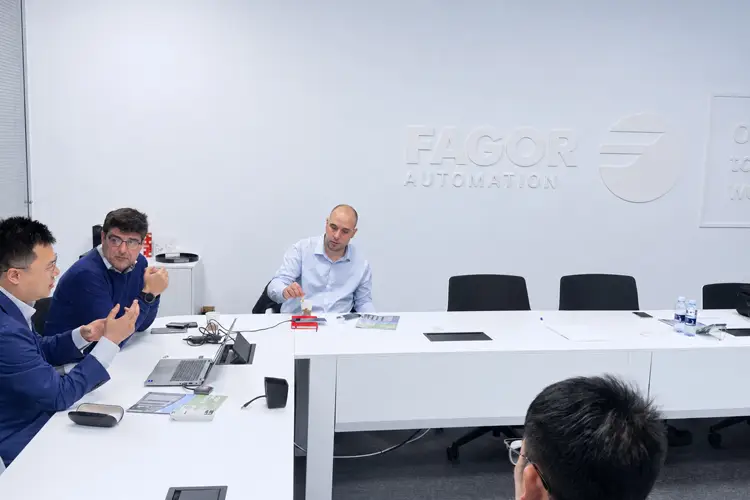
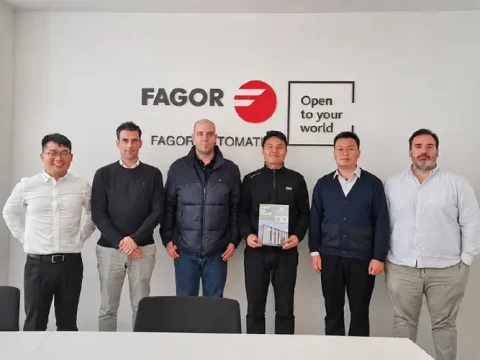
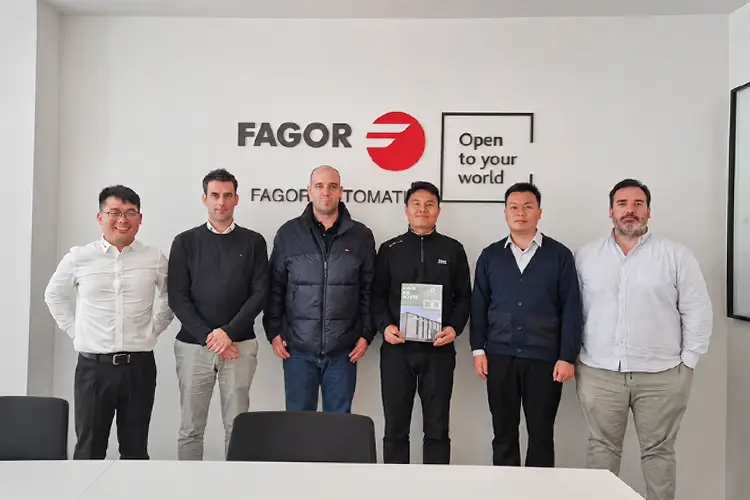
To improve long-term 5-axis machining stability for aerospace composites and large industrial molds, the BCAMCNC engineering team visited FAGOR Automation in Spain for in-depth technical discussions and system optimization cooperation.
During the visit, both teams focused on several critical challenges in advanced composite machining:
- RTCP accuracy during continuous 5-axis movement
- Dynamic gantry synchronization on large-format machines
- Surface consistency in carbon fiber and composite cutting
- Long-hour machining stability for aerospace components
- Post-processor optimization for complex curved surfaces
Rather than simply comparing controller specifications, the discussions focused on real production reliability in aerospace, UAV, marine, and composite material applications.
This cooperation helped BCAMCNC further optimize the integration between FAGOR’s 5-axis CNC control technology and our large gantry machining platforms, improving smooth interpolation performance, machine responsiveness, and long-term operational stability.
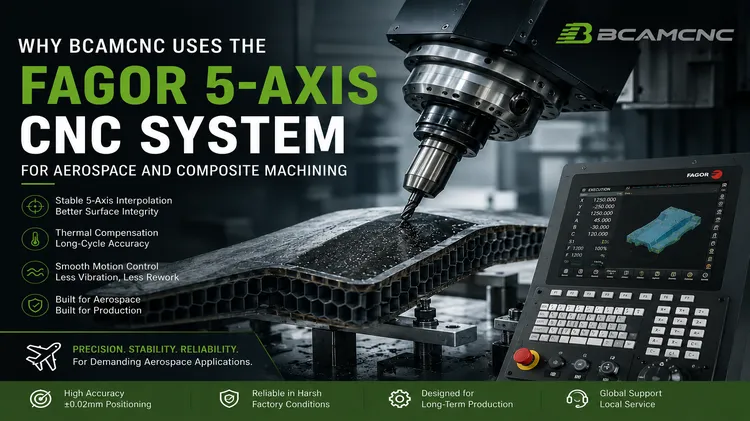
The spindle is rarely the real problem
In composite machining, factories often focus first on spindle power:
- 12 kW
- 15 kW
- HSK63F
- 24,000 RPM
Those specifications matter, but they are usually not what causes production instability.
The bigger issue is motion consistency under continuous 5-axis load.
Carbon fiber, fiberglass, epoxy tooling board, honeycomb panels, and sandwich structures all react differently to:
- heat accumulation
- vibration
- chip evacuation
- tool engagement angle
- acceleration changes
A machine can look perfectly stable while rough-cutting foam and still struggle badly on aerospace-grade CFRP trimming.
Operators notice it first.
You start hearing comments like:
- “slow it down near the corners”
- “surface gets worse after lunch shift”
- “tool life drops randomly”
- “the machine sounds different on curves”
That usually means the controller is fighting the kinematics.
Why BCAMCNC selected FAGOR for these applications
FAGOR Automation has long experience in:
- gantry machining systems
- bridge-type machines
- aerospace tooling
- 5-axis interpolation
- OEM machine integration
For BCAMCNC, several things made practical sense for aerospace and composite production environments.
Stable RTCP behavior during continuous movement

In aerospace composite machining, the tool center point cannot “wander” during simultaneous axis transitions.
On thin-wall composite parts, even small positional instability can create:
- edge delamination
- resin burn
- witness lines
- inconsistent trimming quality
The FAGOR system handles continuous 5-axis interpolation smoothly, especially on long curved toolpaths where lower-end systems tend to hesitate or over-correct.
That hesitation may only last milliseconds.
On the finished part, it becomes visible.
Better handling of large-format gantry dynamics
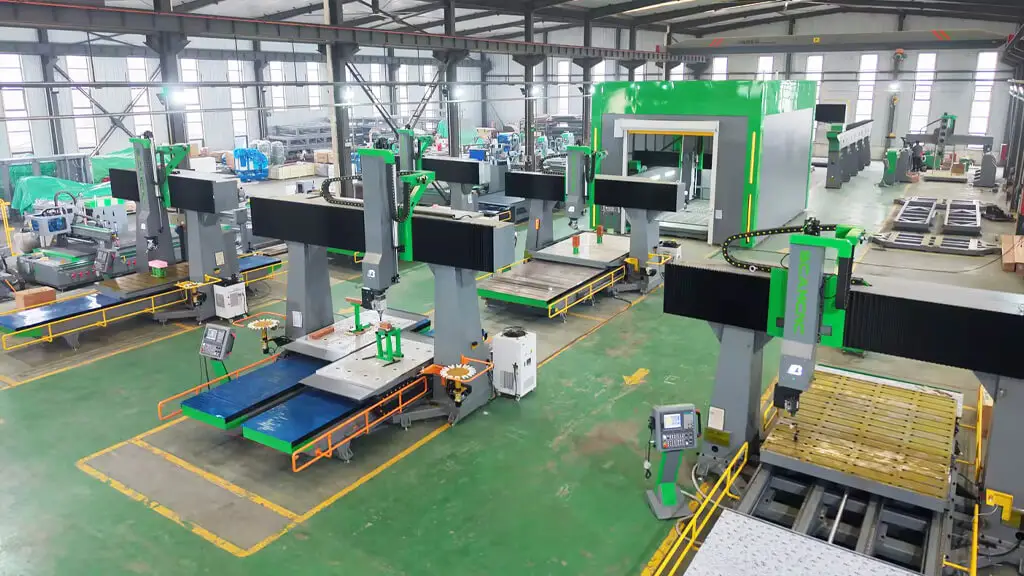
Large aerospace molds and composite structures behave differently from compact metal-cutting applications.
Machine structures handling:
- yacht molds
- wind blade tooling
- fuselage molds
- large CFRP fixtures
often require:
- dual-drive gantries
- long-axis synchronization
- high-speed contouring over large travel distances
This is where control behavior matters more than maximum rapid speed numbers.
A machine capable of 60 m/min rapid travel is meaningless if operators constantly reduce feed override during actual cutting.
Factories do this more often than suppliers admit publicly.
Smoother contour transitions reduce downstream labor
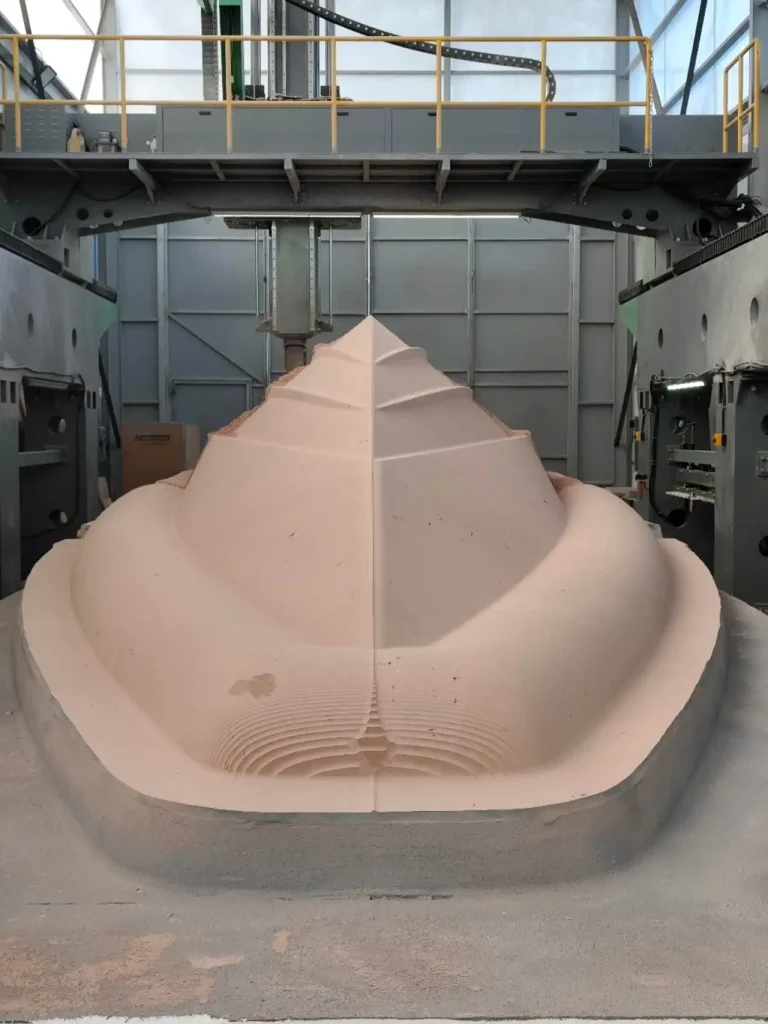
One issue repeatedly underestimated in aerospace composite production is manual finishing labor.
Poor motion smoothing creates:
- micro faceting
- contour marks
- inconsistent edge quality
Then downstream departments spend hours:
- sanding
- filling
- correcting surfaces manually
The machine technically “finished” the part.
Production still lost money.
FAGOR’s spline interpolation and high-speed contour control help reduce these transition marks significantly, particularly on:
- compound curves
- mold surfaces
- aerospace fairings
- composite trimming paths
Not because the machine is magically more powerful.
Because the motion stays more predictable.
Composite machining punishes instability
Aerospace composite production has very little tolerance for inconsistency.
A furniture shop can often sand away small defects.
Aerospace production usually cannot.
Small motion problems become expensive quickly:
- scrap composite material
- failed inspection
- rework labor
- tool breakage
- assembly alignment issues
- delayed delivery schedules
One damaged large composite mold can easily cost more than the price difference between control systems.
This is why experienced production managers often focus less on “machine price” and more on:
- process stability
- repeatability
- maintenance accessibility
- long-cycle reliability
The spreadsheet department and the production department rarely evaluate machines the same way. One looks at purchase cost. The other deals with the consequences afterward.
Thermal drift becomes very real during long shifts
Large-format 5-axis machining generates heat everywhere:
- spindle growth
- ballscrew expansion
- linear guide temperature changes
- servo heating
- environmental fluctuation
Factories running two or three shifts see this constantly.
Especially in workshops where:
- dust extraction changes airflow
- doors stay open during loading
- ambient temperature varies throughout the day
People like discussing micron-level tolerances while machining next to a loading bay open to summer humidity. Manufacturing occasionally operates on optimism held together by compressed air and coffee.
Even a 0.05 mm axial thermal expansion can be enough to create bonding inconsistencies on aerospace-grade honeycomb panels, especially when adhesive gap tolerance is tightly controlled during secondary assembly.
The FAGOR system’s compensation capabilities help reduce long-cycle dimensional variation during extended machining operations.
That matters more in production than impressive demo cuts lasting twelve minutes.
BCAMCNC + FAGOR vs general-purpose 5-axis configurations
| Area | General 5-Axis Router | BCAMCNC + FAGOR Aerospace Configuration |
|---|---|---|
| Main Application | General routing and trimming | Aerospace and advanced composites |
| RTCP Stability | Basic simultaneous motion | More stable continuous 5-axis interpolation |
| Gantry Synchronization | Limited on long-axis structures | Better suited for large-format gantries |
| Surface Transition Quality | Operator-dependent | More consistent contour blending |
| Composite Edge Quality | Higher risk of delamination | Improved stability during trimming |
| Automation Integration | Limited flexibility | Better OEM integration capability |
| Long-Shift Stability | More manual feed adjustment | More predictable production behavior |
| Maintenance Logic | Basic machine service | Designed around industrial production cycles |
This comparison is not about “luxury” versus “economy.”
It is about production tolerance.
There are many affordable 5-axis machines capable of producing acceptable parts.
The problem starts when production volume, geometry complexity, and tolerance requirements increase simultaneously.
That is where machine behavior becomes more important than brochure specifications.
A real production example from a composite tooling factory
A composite tooling manufacturer producing large curved molds for marine and aerospace applications was struggling with inconsistent surface quality during long contour machining operations.
The machine structure itself was not weak:
- welded gantry frame
- HSK spindle
- vacuum table
- quality linear guide system
The issue appeared during simultaneous 5-axis movement on complex surfaces.
Operators repeatedly reduced feed override near contour transitions because:
- vibration increased
- surface marks became visible
- edge quality changed unpredictably
Initially, the factory suspected spindle imbalance.
After reviewing machine behavior and postprocessor output, the larger problem was motion transition instability combined with poor contour smoothing.
The factory later moved to a BCAMCNC configuration using the FAGOR 5-axis system and optimized postprocessing around actual machine kinematics.
The result was not “perfect production.”
No real factory has perfect production.
But the operation became more predictable:
- less manual sanding
- more stable surface quality
- fewer operator feed adjustments
- more consistent tool life
- improved repeatability between shifts
That is usually what mature factories are really trying to buy.
Predictability.
Composite dust destroys equipment slowly
Carbon fiber dust is abrasive and electrically conductive.
Without proper machine protection and cleaning discipline, it eventually affects:
- encoders
- cable tracks
- servo cooling
- pneumatic valves
- electrical cabinets
A surprising number of machine failures are actually maintenance failures that accumulated quietly over time.
This is why BCAMCNC pays close attention to:
- cabinet sealing
- airflow management
- dust extraction compatibility
- cable routing
- maintenance accessibility
Not because those details look impressive in marketing photos.
Because technicians eventually have to service the machine in real factory conditions.
Factory power conditions are rarely stable
A lot of machine testing is done under ideal electrical conditions.
Real factories are different.
Voltage fluctuation, unstable grounding, compressed air pressure variation, and overloaded workshop power lines are common in many production environments, especially in older industrial facilities.
A 5-axis machine running continuous interpolation does not react well to unstable electrical supply.
One reason BCAMCNC values the FAGOR platform for industrial production environments is its relatively strong tolerance to voltage fluctuation and real-world factory conditions compared with many lighter industrial control setups.
That does not eliminate the need for proper power management.
But it reduces unnecessary instability caused by imperfect infrastructure, which is the reality in far more factories than most sales presentations admit.
The cheapest machine can become the most expensive machine
Factories sometimes underestimate the cost of:
- machine downtime
- delayed shipments
- rejected aerospace parts
- operator dependency
- unstable process control
A low initial machine price can disappear very quickly once:
- scrap rates increase
- operators slow production manually
- overtime finishing work becomes normal
That pattern appears repeatedly in composite machining operations trying to run aerospace work on equipment originally intended for lighter industrial routing.
FAQ
Is the FAGOR system suitable for aerospace 5-axis machining?
Yes. FAGOR has strong capability in:
- simultaneous 5-axis interpolation
- gantry machine control
- OEM machine integration
- aerospace tooling applications
- composite machining environments
It is particularly well suited for large-format 5-axis router and gantry systems.
What materials are commonly processed on these machines?
Typical applications include:
- CFRP
- GFRP
- epoxy tooling board
- honeycomb composite panels
- foam-core structures
- composite molds
- aluminum tooling components
Does the control system really affect surface quality?
Absolutely.
Poor interpolation behavior can create:
- contour marks
- feed inconsistency
- vibration
- heat accumulation
- edge damage
In many aerospace composite applications, motion quality matters more than raw spindle horsepower.
What spindle power range is commonly used?
Depending on material and application:
- 9 kW to 15 kW for trimming and lighter composite work
- 18 kW to 24 kW for heavy tooling and large mold applications
Proper tooling strategy and motion stability usually matter more than simply increasing spindle power.
How important is postprocessor optimization?
Extremely important.
Many so-called “machine problems” are actually:
- poor kinematic output
- incorrect smoothing parameters
- unstable tool vectors
- improperly configured CAM postprocessors
Even high-end hardware performs poorly with bad postprocessing logic.
Final thoughts from the shop floor
Most aerospace machining problems do not begin with catastrophic machine failure.
They start with small inconsistencies:
- unstable motion during curves
- thermal variation over long cycles
- operators compensating manually
- vibration nobody investigates properly
- postprocessors that were never fully optimized
- maintenance schedules delayed because production is “too busy”
Eventually those small problems become:
- scrap
- rework
- missed delivery dates
- exhausted operators
- frustrated production managers
BCAMCNC’s integration of the FAGOR 5-axis CNC system is based on a simple manufacturing principle:
Aerospace and composite machining require stable process behavior, not just impressive machine specifications.
The useful question is not:
“How fast can the machine rapid?”
It is:
“How predictable is the process after 2,000 production hours?”