
 Most automotive suppliers do not lose money because a machine is “too slow.” They lose money because the mold leaves the CNC department looking acceptable, then creates problems three processes later.
That was exactly what happened inside a Hyundai Tier-1 supplier in South Korea.
The issue was not whether the machine could cut the part. Almost any decent 5 axis machine can produce a clean demo sample when the application engineer is standing beside it. The real problem started after continuous production:
- surface consistency changed between shifts
- polishing workload kept increasing
- operators constantly adjusted feed rates manually
- composite trimming quality depended too much on programmer experience
- maintenance downtime became unpredictable
The factory originally relied on a mix of older 3 axis routers, one imported European 5 axis machining center, and outsourced overflow work. On paper, the setup still worked. Inside the workshop, engineers were spending too much time compensating for process instability.
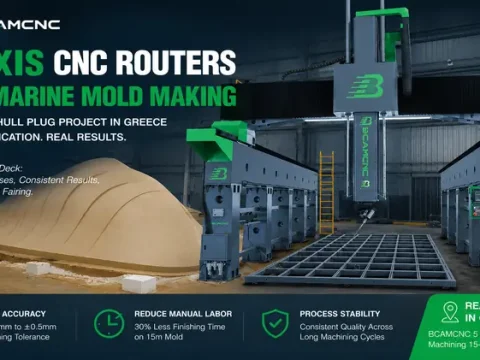
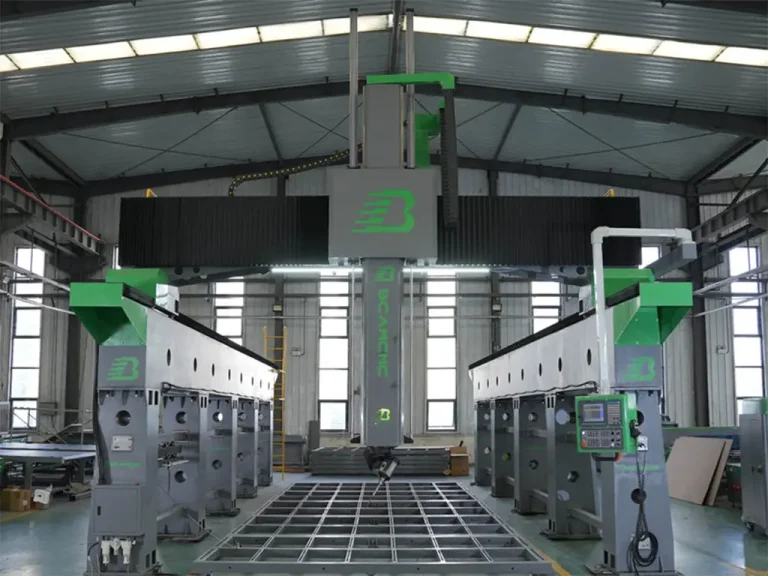
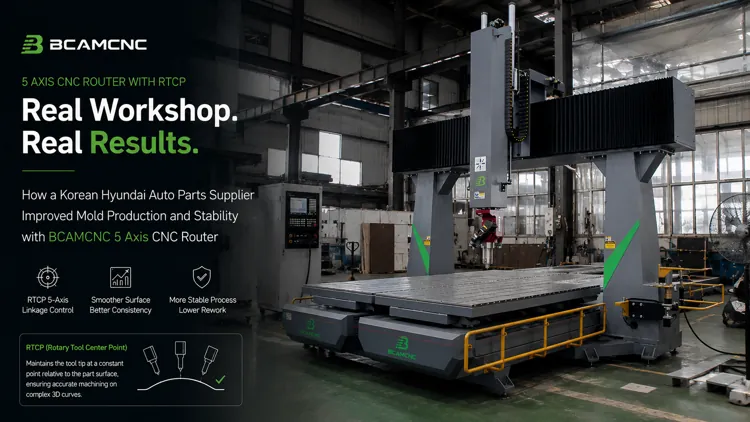
Eventually the customer replaced part of the workflow with a BCAMCNC 5 axis CNC router.
Not because of a brochure specification.
Because mold production was becoming the bottleneck for delivery.
The Real Issue Was Process Stability, Not Maximum Cutting Speed
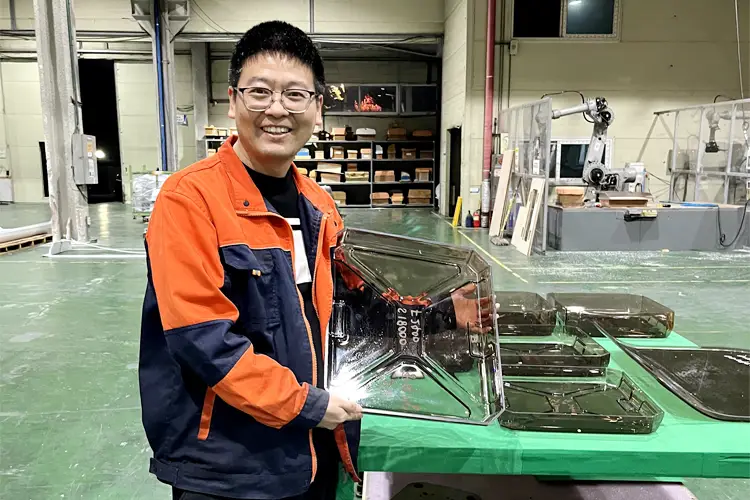
The customer manufactures automotive interior and exterior tooling for Hyundai platforms, including:
- thermoforming molds
- composite layup tooling
- prototype bumper molds
- dashboard vacuum molds
- carbon fiber trim development parts
- checking fixtures
- low-volume aluminum tooling
Like many automotive suppliers in Korea, their production environment sits in an awkward middle ground:
too much product variation for fully dedicated automation, but too much volume to rely on operator experience and manual adjustment.
That creates a very specific machining problem.
The first prototype usually looks fine.
The fifth batch often does not.
Where the Previous Setup Started Failing
The older production line suffered from several small issues that slowly became expensive.
Surface quality drift during long finishing passes
When machining epoxy tooling board and high-density polyurethane board, operators noticed heat buildup during deeper cavity finishing.
The usual response inside the workshop was predictable:
reduce feed rate.
That temporarily reduced chatter.
Then another problem appeared.
Longer tool engagement increased heat concentration around corners and compound curves. Surface marks became inconsistent, especially around steep wall transitions.
Technically, many parts still passed dimensional inspection within ±0.15 mm.
The composite technicians still complained.
Because downstream processes became harder.
The hidden cost was manual rework
This is something machine salespeople rarely discuss properly.
The expensive part was not the cutting cycle itself.
It was what happened afterward:
- extra sanding
- more polishing
- fitting correction
- edge repair
- repeated inspection loops
Some molds required experienced technicians to manually blend transition areas before composite layup could start.
That labor cost quietly became larger than management expected.
One production engineer described it bluntly:
“The machine tolerance looked acceptable on paper. The mold still felt unstable in production.”
That sentence says a lot about automotive tooling reality.
Why the Customer Needed 5 Axis Machining
The engineering department was not specifically looking for “5 axis technology.”
They wanted stable cutter engagement.
Different objective.
Once automotive tooling geometry becomes deeper and more curved, tool angle directly affects:
- surface continuity
- heat generation
- chip evacuation
- dust extraction
- tool life
- edge chipping on resin board
- polishing workload afterward
With the older 3 axis process, programmers compensated using longer tools.
Then rigidity dropped.
Then spindle load fluctuated.
Then feed rates became conservative.
Then finishing quality became operator-dependent.
That cycle is common in automotive prototype shops.
Why They Chose a 5 Axis CNC Router Instead of Another Heavy Machining Center
Internally, there was disagreement.
Some managers initially wanted another European machining center.
The engineering team pushed in a different direction.
Because most of their workload involved:
- resin tooling board
- PU foam
- composite molds
- vacuum forming tooling
- non-ferrous prototype parts
Not hardened steel production.
That changes the purchasing logic completely.
| Production Requirement | Heavy Machining Center | 5 Axis CNC Router |
|---|---|---|
| Composite tooling | Often oversized cost structure | Better cost efficiency |
| Large vacuum table layouts | Usually limited | Easier customization |
| Resin board finishing | Excessive rigidity for application | Better acceleration balance |
| Dust-heavy environment | Higher maintenance sensitivity | Easier maintenance access |
| Foam and prototype work | Low utilization efficiency | Better throughput economics |
| Long continuous finishing paths | Good | Good with lower operating cost |
The final decision came down to production economics rather than machine prestige.
The BCAMCNC Configuration
The installed machine included:
- 5 axis RTCP configuration
- Siemens control system
- HSD spindle
- 10-position automatic tool changer
- hybrid vacuum and mechanical clamping table
- centralized lubrication
- integrated dust extraction
- aggregate tooling capability
The spindle selection was intentionally conservative.
The customer avoided chasing oversized spindle power because most real production time involved finishing operations rather than aggressive material removal.
That matters more than many buyers realize.
Large spindles running continuously at low load are not automatically safer. In many factories they simply increase power consumption while spending most of the day underutilized.
What Actually Improved After Installation
The first improvement was not cycle time.
It was process predictability.
Operators stopped constantly modifying programs at the machine.
That alone reduced a surprising amount of production instability.
Surface consistency improved more than absolute accuracy
This distinction matters.
In automotive composite tooling, surface continuity is often more important than isolated tolerance numbers.
The engineering team focused heavily on:
- smooth rotary transitions
- stable cutter engagement
- reduced vibration during long finishing paths
- repeatable tool orientation
- dust evacuation consistency
After stabilization:
- polishing time dropped noticeably
- finishing quality became more repeatable between shifts
- operator intervention decreased
- tool life became easier to predict
- outsourced correction work was reduced
Not perfect.
No real factory runs perfectly.
But stable enough that scheduling became more reliable.
And for automotive suppliers working under JIT delivery pressure, scheduling stability is often more valuable than theoretical spindle speed.
One unexpected problem: carbon and resin dust
This part almost never appears in machine brochures.
Composite dust is brutal.
Especially:
- carbon fiber dust
- fiberglass particles
- resin tooling board residue
- polyurethane foam powder
Carbon dust is conductive. Fine resin powder gets everywhere.
After roughly two months of continuous production ramp-up, maintenance engineers noticed contamination buildup around rotary protection areas and linear motion components.
Not catastrophic.
But enough to increase preventive maintenance frequency.
The solution was surprisingly simple:
- better extraction positioning
- weekly rotary inspection routines
- improved shift-end cleaning discipline
- positive air pressure inside electrical cabinets
- regular inspection of rail wipers and bellows
Simple maintenance habits prevented much larger downtime problems later.
Factories usually ignore these details until positioning repeatability starts drifting.
A small shop floor observation that mattered
One operator mentioned something interesting during follow-up discussions.
Before the process change, final surface quality depended heavily on which programmer prepared the toolpath.
After the BCAMCNC installation and process standardization, newer operators could consistently reproduce acceptable finishing quality much faster.
That is not only a labor issue.
It is a business continuity issue.
Experienced 5 axis programmers are becoming increasingly difficult to retain in automotive supplier environments.
Reducing dependence on individual operator habits became an important ROI factor for the customer, even though accounting departments rarely calculate it directly.
Real Production Feedback After Six Months
The customer tracked several operational changes after six months of production:
| Production Metric | Previous Workflow | After BCAMCNC Integration |
|---|---|---|
| Manual polishing workload | High | Reduced |
| Program adjustment at machine | Frequent | Occasional |
| Outsourced overflow machining | Common | Reduced |
| Tool life predictability | Inconsistent | More stable |
| Maintenance interruptions | Hard to forecast | Easier to schedule |
| Mold finishing consistency | Operator-dependent | More repeatable |
Interestingly, the biggest financial improvement did not come from faster cutting.
It came from reducing downstream instability.
That is typical in automotive tooling production.
The expensive part is often not the machining itself.
It is everything that happens after the machining.
Factory Floor Problems Most Buyers Underestimate
Dust management matters more than brochure acceleration values
A fast machine running inside a poorly controlled composite environment eventually becomes a maintenance problem.
Linear guide contamination, encoder instability, and rotary wear usually appear gradually, not during machine acceptance testing.
Vacuum systems do not fix poor fixture design
Large vacuum pumps cannot compensate for weak fixture support near trimming areas.
Thin automotive plastic parts flex easily under lateral cutting force.
When the fixture vibrates, tool life drops quickly and edge quality becomes inconsistent.
Spare parts logistics affect real production risk
One reason the supplier moved away from its older imported setup was downtime exposure.
When a spindle or encoder issue requires overseas support with multi-week lead times, JIT production becomes vulnerable very quickly.
That calculation matters more today than many factories admit publicly.
FAQ
Is a 5 axis CNC router rigid enough for automotive tooling production?
For composite molds, resin tooling board, thermoforming tools, foam models, and many aluminum applications — yes.
For aggressive hardened steel machining, that is a different machine category entirely.
The machine must match the material and process structure.
Why do some automotive molds pass inspection but still create production problems?
Because dimensional tolerance alone does not guarantee process stability.
Surface continuity, cutter transition quality, and downstream composite behavior all affect final production results.
Layup technicians usually notice instability before CMM reports do.
Is spindle power the most important specification?
Not usually.
Toolpath stability, vacuum holding quality, machine vibration behavior, and dust protection often affect production quality far more than peak spindle power.
What is commonly underestimated during 5 axis machine purchasing?
Maintenance environment planning.
Especially for carbon fiber and resin machining.
Dust management strategy directly affects long-term repeatability and maintenance cost.
Why do some suppliers choose CNC routers instead of traditional machining centers?
Because the production logic is different.
Large composite tooling and non-ferrous applications often benefit more from working envelope efficiency, lower operating cost, and easier fixture integration than from extreme metal-cutting rigidity.
A Practical Note for Automotive Suppliers Evaluating 5 Axis Equipment
If you are comparing 5 axis machines for automotive tooling production, spend less time asking about maximum rapid speed and more time discussing:
- long-path finishing stability
- RTCP behavior
- dust protection strategy
- vacuum zoning layout
- fixture integration
- maintenance access
- post-processor support
- spare parts lead time
- actual material mix inside your workshop
Most production problems appear six months after installation.
Not during the machine demo.
That is usually where a machine either becomes a stable production asset — or a permanent source of workshop arguments.
At BCAMCNC, most conversations with automotive tooling customers eventually come back to the same question:
“What kind of production instability are you actually trying to eliminate?”